
One of the most common questions new mothers ask before delivery is which maternity pad size to buy — and how many of each. Postpartum pad sizes are not a marketing gimmick; they map directly to how your body heals. Lochia, the discharge that follows childbirth, is heaviest in the first few days and gradually lightens over two to six weeks, so the size you need changes week by week.
This guide breaks down postpartum pad sizes (typically M, L and XL), what each is for, and when to switch between them — so you can buy with confidence instead of guessing.
What Do Postpartum Pad Sizes Mean?
Unlike regular sanitary pads, which are graded mainly by thickness (“normal”, “heavy”, “night”), maternity pads are graded by length and width. A larger size means more surface area to catch fluid while you are lying down, sitting or sleeping — the positions where leaks are most likely.
As a general industry reference, a typical maternity pad range looks like this:
| Size | Typical dimensions | When it is used |
|---|---|---|
| M | roughly 280 × 100 mm | Late postpartum, light flow, daytime |
| L | roughly 360 × 180 mm | Moderate flow, mid recovery, overnight |
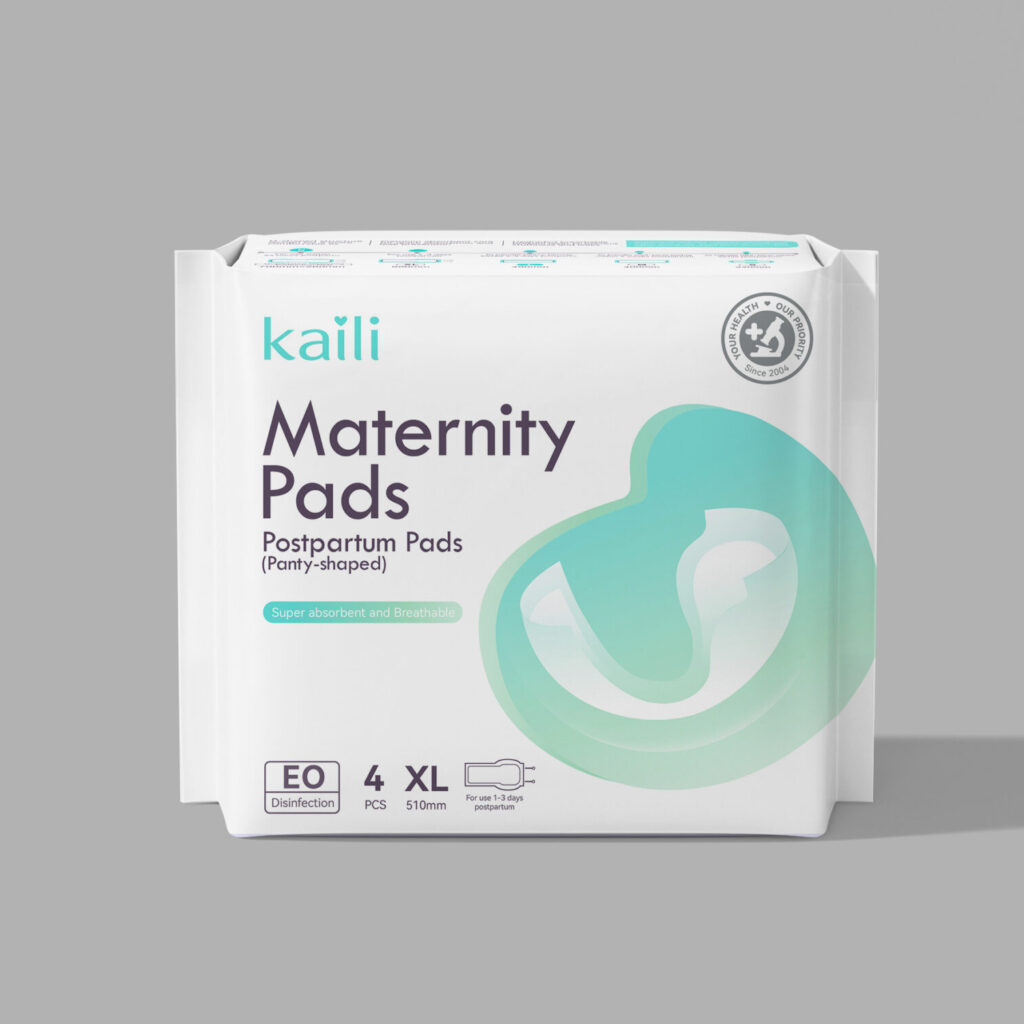
| XL | roughly 420 × 210 mm | Heavy flow, first days after birth, extended wear |
Dimensions vary by manufacturer, so always confirm against the supplier’s specification sheet before you buy. The table above reflects common industry sizing, not a single universal standard.
What does not change between sizes is the core construction. A quality postpartum pad uses a fluff pulp and super absorbent polymer (SAP) core to lock fluid away, a soft non-woven top layer, and a waterproof back sheet. Our guide on SAP vs fluff pulp underpad cores explains how that absorbent core actually works.

If you are new to postpartum care, our Lochia Care 101 guide walks through the three stages of recovery in detail — it is the natural companion to this sizing guide.
When to Use XL Maternity Pads
The XL size is built for the heaviest window — the first two to four days after delivery, when lochia is at its peak (the “rubra” stage, bright red and heavy). During this time you may go through six to eight pads a day.
- Longer coverage reduces the chance of leaks while you are in bed.
- Higher absorbency keeps the surface feeling dry overnight.
- Wider fit protects clothing and bedding when you move from bed to chair.
If you are packing a hospital bag, XL is the size to prioritise. It is also the size most healthcare facilities stock, which is why it is our best-selling distribution product. For wholesale and stock details, see our Maternity Pad XL in-stock wholesale page.
When to Use L Maternity Pads
As flow moves into the moderate, pinkish-brown “serosa” stage (roughly days four to ten), the L size becomes the everyday workhorse. It is long enough for overnight use but less bulky than XL, so it is comfortable during the day once the heaviest bleeding has passed.
- Ideal for the second week of recovery.
- A good overnight option when flow is no longer at its peak.
- Comfortable enough for moving around, not just resting.
Most mothers find L is the size they use the most pads in, simply because it covers the longest stretch of the recovery timeline.
When to Use M Maternity Pads
The M size is for the tail end of recovery — the “alba” stage, from around week two onward, when flow is light and pale. By this point many mothers are tempted to switch back to a regular sanitary pad, and for some that works — but a slimmer maternity pad still offers the extra length and softness that healing skin appreciates.
- Light, daytime protection for late postpartum.
- A step-down option before returning to regular sanitary products.
- Also useful as a compact option for travel or as a diaper booster.
Size vs. Absorbency: Do You Need Both?
A common misunderstanding is that a bigger pad automatically holds more. Size is about coverage area, while absorbency is about core capacity — the amount of SAP and fluff pulp in the core, and how quickly it locks fluid away. An XL pad with a thin core can hold less than an L pad with a dense core.
When you compare suppliers, look at three things together:
- Dimensions — length and width in millimetres.
- Core weight — grams per square metre (gsm), the main driver of absorbency.
- SAP ratio — a higher ratio locks more fluid and keeps the surface drier.
A reputable manufacturer will provide all three on the specification sheet. If a supplier only gives you a size and nothing else, ask for the core weight and SAP ratio before committing.
Postpartum Pad Sizes: A Quick Selection Chart
| Recovery phase | Typical timing | Recommended size | Pads per day (approx.) |
|---|---|---|---|
| Early (rubra) | Days 1–4 | XL | 6–8 |
| Middle (serosa) | Days 4–10 | L | 3–5 |
| Late (alba) | Weeks 2–6 | M | 1–3 |
The numbers above are a planning guide, not a rule. Some women have lighter or heavier flow, and caesarean recovery can differ from vaginal delivery. The safe approach is to buy a mixed pack — more XL for the first week, plenty of L for the middle, and a smaller supply of M — and top up only if you run low.
What About Even Larger Sizes?
Some manufacturers offer sizes beyond XL, sometimes labelled XXL, or shaped “perineal” pads with cooling gel for comfort after stitches. If your supplier offers these, they can be a useful add-on for the first days. The core guidance stays the same: match the size to the stage of flow, and confirm the specification before ordering in bulk.
FAQs
What size maternity pad do I need after giving birth? Start with XL for the first few heavy days, move to L for the moderate middle stage, and finish with M as flow becomes light. Buying a mixed pack that skews toward XL and L is the most practical approach.
How many postpartum pads should I pack? For the hospital bag, plan for around 20–30 XL pads to cover the first days comfortably. For home, roughly 45–55 pads across the first week is a sensible buffer, then fewer each week as flow lightens.
Can I use a regular sanitary pad instead of a maternity pad? For the first heavy days, a regular pad is usually not long or absorbent enough, especially overnight. You can transition back to regular pads as flow becomes light in the later weeks.
Are all maternity pad sizes the same across brands? No. Dimensions and core weight vary between manufacturers, so a “L” from one supplier can differ from another’s. Always confirm the millimetre dimensions and gsm on the specification sheet.
Do bigger pads always absorb more? Not necessarily. Coverage (size) and absorbency (core weight and SAP ratio) are separate. Check the core specification, not just the size label. For a side-by-side look at how maternity pads differ from regular pads, see our Maternity Pads vs. Regular Pads comparison.
Looking for a reliable maternity pad supply partner? As a manufacturer with 20 years of experience and ISO 13485 and CE certified production, we supply high-absorbency maternity pads in M, L and XL with OEM/ODM options and ready-to-ship stock. Get in touch for specification sheets, sizes and free samples.
📧 [email protected] | 📱 +86 18029836946 (WhatsApp)

