
If you manage a nursing home, assisted-living facility, or long-term care ward, disposable underpads are one of those quietly essential supplies that affect almost everything else — resident comfort, skin health, laundry workload, and your monthly budget. Get the spec right and your staff saves time while residents stay dry and dignified. Get it wrong and you burn through pads, irritate skin, and field complaints.
This guide breaks down exactly what to look for when sourcing disposable underpads for nursing homes, from absorbency and size to materials, certifications, and bulk-ordering tips.

Why Disposable Underpads Matter in Long-Term Care
Incontinence is extremely common among elderly residents — studies put it above 50% in many care-home populations. Without reliable protection, a few problems stack up fast:
- Mattress and linen damage. A single overnight accident can ruin a mattress without a waterproof layer underneath.
- Skin breakdown. Prolonged moisture leads to incontinence-associated dermatitis and pressure ulcers, which are painful, slow to heal, and expensive to treat.
- Staff workload. More laundry cycles and bed changes mean more labor hours.
- Infection control. Disposable, single-use pads reduce cross-contamination versus repeated washing.
A good disposable underpad sits between the resident and the sheet, absorbs fluid fast, locks it away, and keeps the surface dry. That single product protects skin, linen, and your team’s time.
1. Start With Absorbency (and SAP Content)
Absorbency is the first number to check, and it comes down to what’s inside the pad. Most quality underpads use a core of fluff pulp + super absorbent polymer (SAP). The SAP does the heavy lifting: it turns liquid into a gel so the surface stays dry.
Roughly, you can group absorbency into three tiers:
- Light (≈300 ml): short procedures, exam chairs, daytime chair use.
- Medium (≈400 ml): standard bed protection, mobile residents.
- Heavy (500 ml+): overnight use, bedridden residents, high-output incontinence.
For nursing homes, medium-to-heavy is the safe default for beds, with lighter pads reserved for chairs and wheelchairs. If a supplier won’t tell you the SAP grammage or absorption in ml, treat that as a red flag.
Internal link: See our Adult Underpad specifications for sizes, weights, and SAP options.
2. Choose the Right Size for the Setting
Size dictates where the pad works. Here’s the practical map most care facilities use:
| Size | Best use in a care facility | Typical absorption |
| 60 × 90 cm | Standard bed liner / “bed pad” — the workhorse | Heavy |
| 60 × 60 cm | Wheelchairs, recliners, smaller beds, lap protection | Medium |
| 45 × 33 cm | Exam tables, short procedures, lap trays | Light |
| Custom | Facility-specific beds, bariatric needs | Per spec |
The 60×90 cm size is the one you’ll reorder most. It covers the hip-and-pelvis zone where leaks happen and tucks under the bottom sheet. Keep a smaller size on hand for chairs and transport.
3. Material & Layer Structure (the 5-Layer Build)
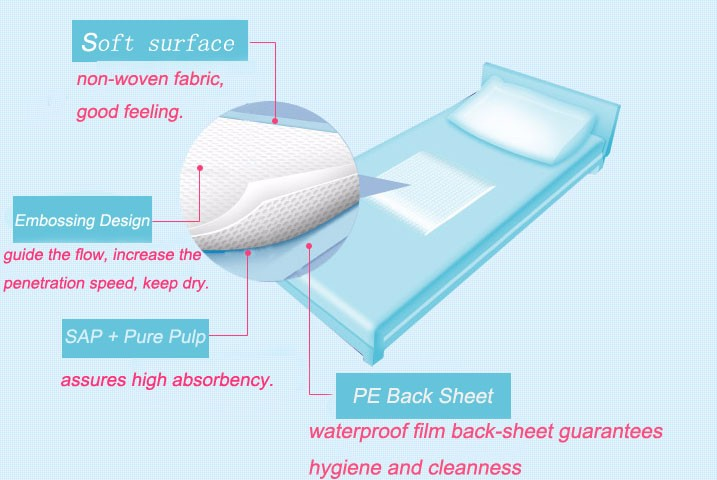
A disposable underpad is not just a towel. A proper medical-grade pad is built in layers, and each layer has a job:
- Top sheet — soft non-woven fabric that wicks fluid away from skin and feels comfortable.
- Tissue layer — distributes liquid evenly into the core.
- Fluff pulp + SAP core — stores and gels the fluid.
- Second tissue layer — stabilizes the core.
- Back sheet — waterproof PE film (or clothlike backsheet) that blocks leaks onto the mattress.
When comparing suppliers, ask what the top sheet and back sheet are made of. A breathable, clothlike backsheet is more comfortable and less clammy than basic plastic, though PE film is the cheaper, fully waterproof option and works fine under sheets.
4. Skin-Friendliness & Breathability
Residents often lie on these pads for hours, so skin contact matters. Look for:
- Hypoallergenic, latex-free materials.
- A breathable backsheet that lets air pass while blocking liquid — this reduces heat buildup and helps prevent rashes.
- Neutral pH and no added fragrances (fragrance can irritate sensitive skin).
If your supplier can show third-party skin-safety or material test reports, that’s a strong trust signal.
5. Certifications You Should Require
For care facilities — and especially for importers — certifications are not paperwork, they’re proof. At minimum, ask for:
- ISO 13485 — quality management for medical devices (the most relevant one for underpads).
- ISO 9001 — general quality management system.
- CE — required for the European market.
- GMP — good manufacturing practice; indicates a clean, controlled production environment.
A manufacturer running a GMP-certified clean workshop with microbiological testing (as we do) is simply a safer bet than an unverified trader. Request the actual certificate copies before a large order.
Internal link: Learn about our production and certifications.
6. Odor Control & Leak Guards
Two features materially improve day-to-day life on a care floor:
- Leak-proof edges — sealed borders that stop fluid from escaping sideways onto the sheet.
- Diamond or quilted embossing — keeps the core in place and speeds absorption, which also helps control odor by locking fluid away from air.
If odor is a recurring complaint in your facility, step up to a higher SAP content rather than just changing brands.
7. Bulk Buying & OEM for Nursing Home Groups
Most nursing homes buy by the pallet, not the pack. A few bulk-ordering points:
- MOQ: reasonable starting volumes make trial orders possible; ask for a tiered price so cost per piece drops as volume rises.
- Custom packaging: many groups print their own facility name or a simple instruction graphic on the pack — useful for night-shift staff.
- Private label / OEM: if you operate multiple sites or a brand, OEM lets you standardize one pad across all locations.
- Lead time: confirm production and shipping windows before flu-season demand spikes.
- Free samples: always test a sample for real absorption and comfort before committing to a container.
We offer OEM/ODM underpads with customizable size, weight, SAP level, color, and packaging, plus free samples for testing.
Internal link: Browse all underpad products and categories.
Quick Nursing Home Underpad Checklist
Before you sign a supplier, run through this:
- Absorbency stated in ml (not just “super absorbent”)
- 60×90 cm available as a standard bed size
- 5-layer structure with SAP core
- Waterproof, ideally breathable, backsheet
- Hypoallergenic, latex-free top sheet
- CE / ISO13485 / ISO9001 / GMP certificates on file
- Leak-proof edges + embossed core
- MOQ and unit price that fit your volume
- Free samples offered before bulk order
How Many Underpads Will You Need? (Rough Math)
A simple way to estimate: take the number of incontinent residents, multiply by average changes per day (often 3–5 for bed pads), then add chair-pad usage. A 50-bed home averaging 4 bed-pad changes per resident per day is looking at roughly 200 underpads daily — about 6,000 per month. Knowing this number lets you negotiate per-piece pricing and avoid mid-month stockouts.

FAQs
What size underpad is best for nursing home beds? The 60×90 cm (about 24×36 in) pad is the standard bed liner for most care facilities. It covers the pelvic zone and tucks under the sheet. Use 60×60 cm for chairs and wheelchairs, and 45×33 cm for exam or lap use.
Are disposable underpads better than reusable for elderly care? For most nursing homes, yes. Disposable pads remove laundering labor, reduce cross-contamination, and guarantee a fresh waterproof layer every time. Reusable pads can work for light, low-volume cases but add laundry cost and infection-control complexity.
What certifications should nursing home underpads have? Look for ISO 13485 (medical device quality), ISO 9001, CE marking, and GMP manufacturing. These confirm the product is made in a controlled, tested environment suitable for care settings.
Can we order underpads with our own branding? Yes. Most manufacturers offer OEM/ODM services — custom size, weight, SAP level, color, and printed packaging. This is common for multi-site care groups and private-label distributors.
How much do bulk disposable underpads cost? Unit price depends on size, SAP content, and order volume, and is usually quoted per piece or per pack at a given MOQ. The best approach is to request samples and a volume quote, then compare cost-per-use rather than sticker price alone.
Ready to source? Request a quote or free samples from our team — we’ll return a spec sheet and pricing within 24 hours. 📧 [email protected] | 📱 +86 18029836946 (WhatsApp)
China Underpad Manufacturer — 20 years of OEM/ODM underpad production, ISO13485 & CE certified, GMP clean-room facility in Guangzhou, China.

