
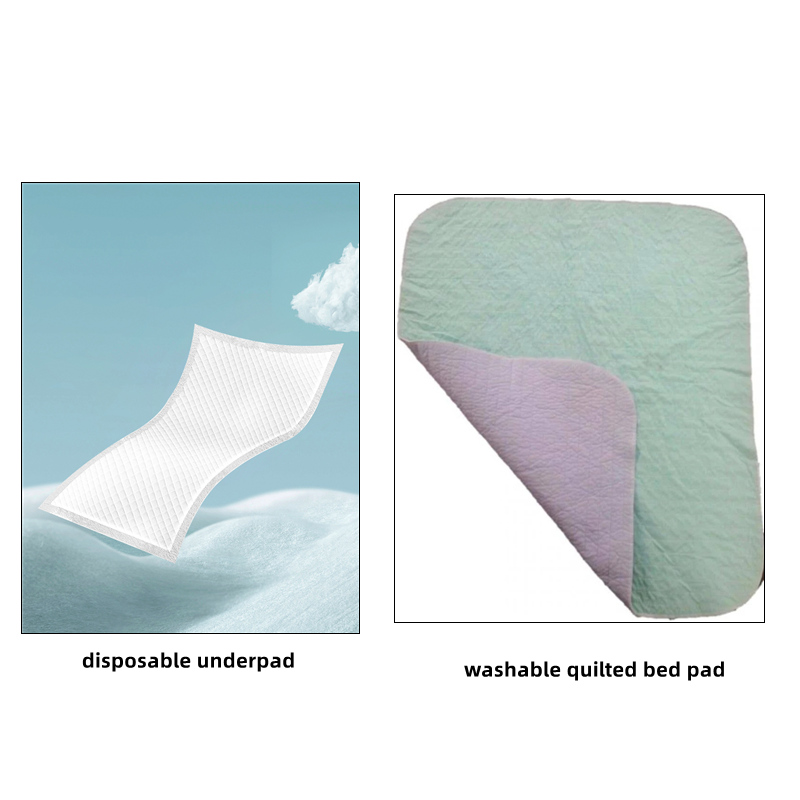
If you’ve spent any time sourcing incontinence supplies, you’ve probably noticed that “underpad,” “bed pad,” “chux,” and “mattress protector” get used almost interchangeably — sometimes on the same product page. That ambiguity causes a very expensive mistake: ordering a “bed pad” that turns out to be a waterproof sheet with no absorbency at all, then watching fluid pool on the surface.
So let’s clear it up properly. Here’s how an incontinence underpad actually differs from a bed pad, when you need each, and why many care facilities end up using both.
Image suggestion: side-by-side photo of a disposable underpad (left) and a washable quilted bed pad (right). Alt text: “incontinence underpad vs bed pad comparison”.
The Short Answer
| Incontinence Underpad | Bed Pad | |
|---|---|---|
| Main job | Absorb and lock away body fluid | Protect the mattress or surface underneath |
| Absorbency | High — SAP core, typically 300–1,000 ml | Varies — some absorbent, some purely waterproof |
| Lifespan | Single-use, disposed after each change | Often washable/reusable (or disposable in heavy cases) |
| Best for | Moderate-to-heavy incontinence, overnight, bedridden residents | Light protection, extending mattress life, layering |
| Cost model | Recurring consumable | One-time purchase, or consumable if disposable |
| Typical settings | Hospitals, nursing homes, post-op care | Home care, light incontinence, mattress protection |
If you need something that absorbs, you want an incontinence underpad. If you mainly need to protect a mattress from small accidents — or you want a washable base layer — a bed pad is the right tool.
Why the Terms Overlap (and Why It Costs Buyers Money)
Here’s the honest truth from the manufacturing side: in the trade, “underpad” and “bed pad” frequently describe the same rectangular absorbent pad. A disposable 60×90 cm pad might be sold under either name.
The distinction that actually matters is not the label — it’s what the product is built to do:
- Absorbent pads (most disposable underpads, some washable pads) — have an absorbent core that pulls fluid in and holds it.
- Non-absorbent protectors (many “mattress protectors” and some thin bed pads) — are just a waterproof membrane. Fluid sits on top. Fine for a tiny leak, useless for real incontinence.
Before you order, always ask one question: what is the absorption capacity in millilitres? If a supplier can’t answer, you may be buying category 2 when you need category 1.
What Is an Incontinence Underpad?
An incontinence underpad is a disposable, absorbent pad placed under the person (not inside underwear) to protect the sheet beneath. A medical-grade pad is built in five layers:
- Non-woven top sheet — soft against skin, wicks moisture away fast.
- Tissue layer — spreads fluid evenly into the core.
- Fluff pulp + SAP core — the SAP (super absorbent polymer) gels the liquid so the surface stays dry.
- Stabilising tissue layer.
- Waterproof PE film back sheet — stops anything reaching the mattress.
Standard sizes: 60 × 90 cm for beds, 60 × 60 cm for chairs and wheelchairs, 45 × 33 cm for exam or lap use — with custom sizes available for bariatric or specialist beds.
Internal link: See full specifications for our Adult Underpad, including sizes, weights and SAP options.
What Is a Bed Pad?
“Bed pad” is the looser term, and it generally covers two different products:
- Washable / reusable bed pad — a quilted, multi-layer fabric pad designed to be laundered dozens of times. Good absorption for light-to-moderate needs, lower long-term cost if you have laundry capacity, but it adds washing labour and needs a full dry cycle before reuse.
- Disposable bed pad — functionally the same as an incontinence underpad, just marketed under a different name. This is what most care facilities actually use.
A third product sometimes gets bundled in: the mattress protector, a fitted or flat waterproof cover with essentially no absorbency. Useful as a last line of defence, but not a substitute for a pad.
How to Choose: Four Questions
Work through these before you place an order.
1. How much fluid are we dealing with? Light seepage or occasional drips → a washable bed pad is usually enough. Full bladder voids or overnight protection → you need a disposable underpad with a SAP core.
2. How often will it be changed? If a resident needs 3–5 changes a day, disposables are almost always cheaper once you factor in labour, water, detergent and dryer time.
3. Do you have laundry capacity on site? Washable pads only pencil out if you can reliably wash, dry and return them the same day. If laundry is outsourced or short-staffed, disposables win.
4. What surface are you protecting? A mattress justifying a £/$1,000+ replacement is worth a belt-and-braces approach. A wheelchair or recliner usually needs a smaller, lighter pad.
When to Use an Incontinence Underpad
Choose a disposable underpad when:
- The resident is bedridden or largely immobile and needs reliable overnight protection.
- Incontinence is moderate to heavy, or output is unpredictable.
- You’re managing infection control — single-use removes cross-contamination risk.
- You’re short-staffed and need to minimise bed-change time.
- It’s post-operative or short-stay care, where laundry logistics don’t make sense.
When a Bed Pad Makes More Sense
A washable bed pad is the better choice when:
- Incontinence is light and predictable (small leaks, not full voids).
- You’re protecting a new or expensive mattress from occasional accidents.
- The setting is home care with a family member handling laundry.
- Sustainability targets matter and you want to cut single-use waste.
- You want a reusable base layer under a disposable pad (see below).
Can You Use Both Together? (Most Facilities Do)
This is the setup many nursing homes quietly run, and it’s usually the most economical:
A washable bed pad underneath, a disposable underpad on top.
- The disposable pad does the absorbing and gets thrown away after each change.
- The reusable pad underneath catches any overflow and protects the mattress.
- Result: far fewer full bed-strip and laundry cycles, and the mattress never sees moisture.
If you go this route, use a smaller and lighter disposable pad than you would on its own — the reusable layer is your safety net, so you don’t pay for maximum absorbency you don’t need.
Image suggestion: simple diagram showing mattress → washable bed pad → disposable underpad → resident. Alt text: “how to layer a disposable underpad over a washable bed pad”.
Rough Cost Comparison
Numbers vary by region, but the shape of the maths is consistent:
- Disposable underpad: roughly a few cents to around twenty cents per piece depending on size and SAP content. Cost scales directly with number of changes.
- Washable bed pad: a higher upfront cost per pad, amortised over 50–100+ washes — plus the labour, water, energy and detergent each cycle.
The crossover point is usually staff time. Once you price a caregiver’s minutes per bed change, disposables tend to win in institutional settings, while washables stay ahead in low-frequency home use.
Quick Buyer’s Checklist
- [ ] Absorption stated in ml (not just “super absorbent”)
- [ ] SAP + fluff pulp core, 5-layer construction
- [ ] Waterproof (ideally breathable) back sheet
- [ ] 60×90 cm available as the standard bed size
- [ ] Hypoallergenic, latex-free, fragrance-free
- [ ] ISO 13485 / ISO 9001 / CE / GMP certification on file
- [ ] Reusable option available if you want to layer
- [ ] MOQ and per-piece pricing that fits your volume
Internal link: Not sure which spec fits? Browse all underpad products and categories, or read about our certified production.
FAQs
Are underpads and bed pads the same thing? Often, yes — the terms are used interchangeably in the trade, and many disposable products are sold under both names. The real difference is whether the product actually absorbs fluid. Always check the stated absorption capacity in ml rather than relying on the label.
Can I put an underpad on top of a mattress protector? Yes, and it’s good practice. The mattress protector is your waterproof last line of defence; the underpad does the absorbing on top. Just make sure the protector is breathable, or it can trap heat underneath.
Which is better for bedridden patients? A disposable incontinence underpad, in a heavy absorbency grade, sized 60×90 cm. Bedridden residents can’t shift position to avoid moisture, so fast absorption and a dry surface are critical for preventing skin breakdown.
Do disposable underpads work for heavy overnight incontinence? They do, provided you choose a high-SAP grade (500 ml+). For very heavy output, layer a disposable pad over a washable bed pad, or size up — overnight is not the place to economise on absorbency.
Can I source both disposable and reusable options from one supplier? Most manufacturers specialise in one or the other. We produce disposable underpads with OEM/ODM options — size, weight, SAP level, colour and custom packaging — and can advise on how to combine them with reusable layers.
Still deciding? Send us your usage scenario — resident numbers, changes per day, and whether you have on-site laundry — and we’ll recommend a spec (and send free samples) within 24 hours. 📧 [email protected] | 📱 +86 18029836946 (WhatsApp)
China Underpad Manufacturer — 20 years of OEM/ODM underpad production, ISO13485 & CE certified, GMP clean-room facility in Guangzhou, China.

