

If you are sourcing disposable underpads for your brand, hospital group, or nursing-home network, two numbers will drive your entire purchasing decision before price even enters the conversation: MOQ (minimum order quantity) and lead time. Get them right and you can plan inventory, lock in a launch date, and protect your cash flow. Get them wrong and you either overpay for stock you cannot move or miss your selling season entirely.
This guide breaks down what a realistic underpad MOQ and lead time looks like when buying from a Chinese manufacturer, what actually moves those numbers up or down, and the questions you should ask before signing a purchase order.
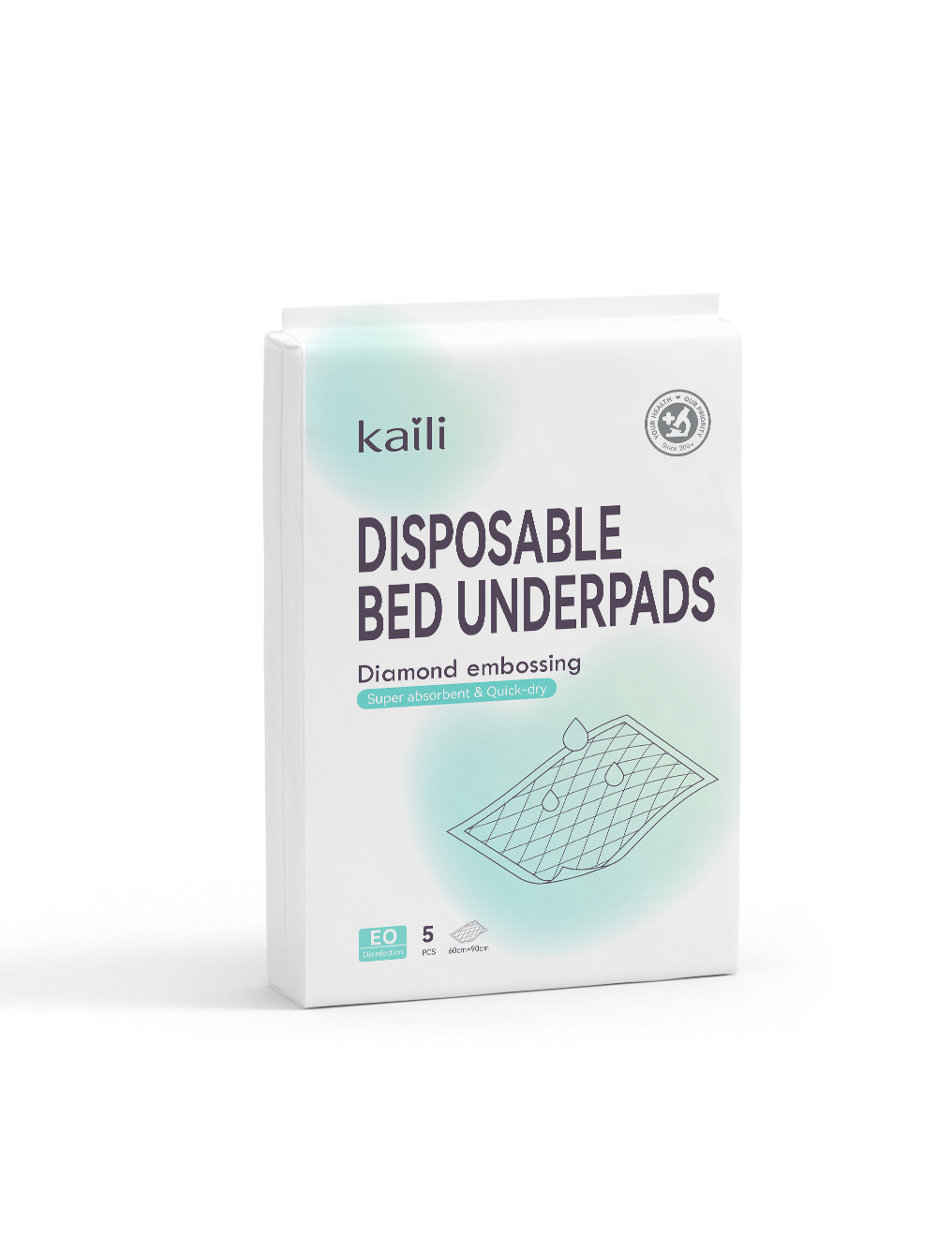
What Is a Normal Underpad MOQ?
MOQ exists because underpads are a low-margin, high-volume product. A factory needs a minimum run to justify the raw materials (fluff pulp, SAP, non-woven topsheet, and PE backsheet), the machine setup, and the labor before the unit economics make sense. As Investopedia explains, a minimum order quantity is the smallest quantity a supplier will produce or sell in a single order, and it exists to keep per-unit costs viable for the producer.
In practice, most Chinese underpad manufacturers structure MOQ around packaging type:
| Packaging type | Typical MOQ |
|---|---|
| Plastic bag (PE bag) packing | 30,000 pcs |
| Box (carton) packing | 50,000 pcs |
These are the figures we publish on our own quote request page, and they are representative of the industry. A supplier quoting you an MOQ of only 500 or 1,000 pieces is usually a trading company reselling stock, not a factory — which matters if you need consistent quality or custom sizing.
Why Box Packing Has a Higher MOQ
Box packing costs more per unit to produce and requires more storage and shipping volume, so factories want a larger order to absorb that overhead. If you are flexible on packaging, choosing bag packing is the single fastest way to lower your MOQ.
What Affects Underpad Lead Time?
Lead time is the window from confirmed order to the goods leaving the factory (or FOB port). For disposable underpads, a standard production lead time typically runs 15 to 30 days, with several variables that can push it either direction.
| Factor | Impact on lead time |
|---|---|
| Stock vs. custom production | In-stock standard sizes ship fastest; custom sizes/logos add days |
| Raw material availability | SAP and fluff pulp lead times fluctuate with global supply |
| Printing & packaging | Custom printed film or boxes add 5–10 days |
| Order size | Very large orders may need multiple production runs |
| Peak season | Q3–Q4 and pre-holiday periods can add 1–2 weeks |
Stock vs. Custom: The Biggest Variable
If you order standard sizes like 60×90 cm, 60×60 cm, 60×45 cm, or 45×33 cm in common colors and weights, many factories keep these in stock or run them on a near-continuous basis, which can shorten lead time significantly. Custom work — a private-label logo, a bespoke size, or a specific absorbency (from 40 gsm up to 100 gsm) — moves you into made-to-order territory and adds days to the front end.
How MOQ and Lead Time Work Together
The two numbers are linked, and smart buyers negotiate them as a package. Here is how the trade-off usually plays out:
- Lower MOQ → longer lead time. If a factory accepts a smaller first order, it will often batch your order with other customers’ production, meaning you wait for the next scheduled run.
- Higher volume → better priority. A larger order is more attractive, so it can earn you a guaranteed production slot and a firmer delivery date.
- In-stock → fastest of all. For a best-selling distribution product like a standard adult underpad, ready-to-ship stock can cut the whole cycle to days rather than weeks.
For a deeper look at how the core material choice changes performance and cost, see our comparison of SAP vs. fluff pulp underpad cores.
Questions to Ask Before You Commit
Before you sign, put these five questions to your supplier in writing. A factory that answers them clearly is one you can work with long-term.
- What is the MOQ for bag packing vs. box packing? Confirm both numbers, not just one.
- Is this product in stock, or is it made to order? This single answer tells you most of what you need to know about lead time.
- What is the current production lead time, and what could delay it? Ask about raw-material lead times and peak-season risk specifically.
- Can you hold stock or offer split shipments? Useful if you want to test a market before committing to a full container.
- What are your payment and quality terms tied to the lead time? Confirm when the clock starts (deposit received vs. PO signed).
Why Chinaunderpad Makes This Easier
At Chinaunderpad, we are a 20-year underpad manufacturer serving 2,000+ maternity hospitals, with ISO 9001 and ISO 13485 certification, CE and CFS marks, a GMP cleanroom, and 13 patents. That factory depth is what lets us hold in-stock standard sizes and offer OEM/ODM customization on size, weight, color, logo, and packaging — so your MOQ and lead time reflect a real production plan, not a reseller’s guesswork.
If you are comparing suppliers, our guide on OEM vs. ODM underpads explains which model fits your business model, and our underpad certification breakdown shows you exactly which credentials to verify before you pay.
The Bottom Line
Underpad MOQ and lead time are not fixed numbers — they are a negotiation driven by packaging, stock status, customization, and order size. Expect roughly 30,000–50,000 pieces depending on packaging, and 15–30 days for standard production. The best way to shorten both is to order in-stock standard sizes from a true factory rather than a trading company.
Ready to get exact numbers for your order? Request a quote and our team will reply within 24 hours with a firm MOQ, lead time, and pricing for your specific specification — plus free samples so you can verify quality before you commit.

