

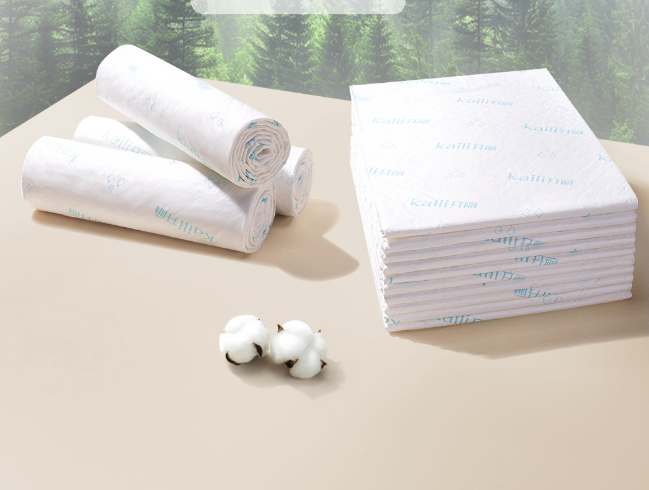
If you import disposable underpads, bed pads, or incontinence pads, one number shows up on every commercial invoice, packing list, and customs declaration: HS code 48189000. Getting it right determines your duty rate, whether your shipment clears customs without delay, and — in some markets — whether you owe additional tariffs. Get it wrong, and you risk duty re-assessment, penalties, and a container held at the port. This guide explains what HS code 48189000 is, why disposable underpads fall under it, how it maps to each major market’s tariff schedule, and how to declare it correctly on your import documents.
What Is HS Code 48189000?
The Harmonized System (HS) is the six-digit classification system that nearly every country uses to identify traded goods. Disposable underpads sit under Chapter 48 (paper and paperboard), heading 48.18, which covers bed sheets and similar household, sanitary or hospital articles, of paper pulp, paper, cellulose wadding or webs of cellulose fibers.
Breaking the full code down:
- 48 — Chapter 48, paper and articles of paper pulp
- 18 — Heading 48.18, sanitary or hospital articles of paper, cellulose wadding, or cellulose-fiber webs
- 90 — Subheading 48.18 90, “Other” (articles not separately enumerated)
- 00 — the national or statistical split used by many countries
In plain terms, HS code 4818.90 (often written 48189000) is the international “bucket” for disposable absorbent pads classified by their paper-pulp core. It is the code customs authorities in the US, EU, UK, and most other markets use for disposable underpads.
Why Underpads Are Classified as “Paper” — Not Textile
This is the part that surprises most buyers. A disposable underpad is a composite of several materials: a nonwoven top layer, an absorbent core of fluff pulp and super absorbent polymer (SAP), and a plastic (PE) backsheet. It looks like a textile, but it is classified under the paper chapter.
The reason is the General Rules of Interpretation (GRI), specifically GRI 3(b). For a composite good, the article is classified according to the component that gives it its essential character. In a disposable underpad, the fluff-pulp core is what actually does the job — drawing in and retaining liquid — and it typically exceeds every other layer by weight. That is why customs rulings on disposable underpads consistently land at 4818.90, rather than a textile or plastic classification.
This distinction matters commercially, because it usually means a lower or even duty-free rate compared to a textile classification — and it is worth confirming with your supplier before you finalize a purchase. The core construction is what makes the classification; see our technical breakdown of SAP vs fluff pulp underpad cores to understand why the pulp core defines the product.

HS Code 4818.90 by Market
The six-digit HS code is harmonized globally, but each country adds its own national digits and duty rates. Here is how the underpad HS code maps across the main import markets:
| Market | Tariff code | Typical duty rate | Notes |
|---|---|---|---|
| United States | 4818.90.0080 | Free (general rate) | Products of China may also require Chapter 99 subheading 9903.88.15 (Section 301, +7.5%) |
| European Union | 4818 90 | Varies by country | Confirm via EU TARIC; VAT applies on top of duty |
| United Kingdom | 4818 90 | Varies | Use the UK Global Tariff lookup |
| Canada | 4818.90.00 | Varies | Check the Customs Tariff schedule |
| Australia | 4818.90.00 | Varies | Confirm via the DCS tariff tool |
Always confirm the current rate with the destination country’s official tariff database before importing — for the US, the authoritative source is the USITC HTS lookup — because rates and additional duties (such as Section 301 tariffs on goods from China) change over time.
How to Declare HS Code 48189000 Correctly
A small error on your declaration can cascade into delays and costs. Follow these steps to declare disposable underpads accurately:
- Confirm the code with your supplier first. Ask your factory for the HS code they use on export documents — it should match what your broker files on import.
- Check the exact national subheading. 4818.90 is the shared part; your market may add digits (for example, 4818.90.0080 in the US). File the full national code, not just the six-digit version.
- Match the product description. Declare the goods as disposable underpads, bed pads, or incontinence pads with their construction (nonwoven top, fluff pulp/SAP core, PE backsheet) — a vague description invites scrutiny.
- Report additional duties where required. For US imports of Chinese goods, report the Chapter 99 subheading (9903.88.15) in addition to 4818.90.0080.
- Keep supporting documentation. Invoices, packing lists, and any customs ruling you have obtained should stay with the shipment to resolve questions quickly.
If you are importing through a customs broker, give them the full tariff code and the product construction details up front — this alone prevents most classification disputes at the border.
Related HS Codes to Watch For
Disposable underpads are not the only absorbent products in a hygiene buyer’s sourcing basket, and nearby categories carry different codes. Do not lump them together:
- Maternity pads and sanitary napkins are generally classified elsewhere (often under textile or a different sanitary-article heading) — confirm each SKU separately.
- Adult diapers and baby diapers fall under their own headings, not 48.18.
- Pet training pads may classify differently depending on construction, so verify before consolidating orders.
If your order mixes underpads with other products, each line item needs its own correct HS code — consolidating everything under 48189000 is a common and costly mistake.
Why Getting the HS Code Right Protects Your Margin
The HS code is not a formality; it is a direct cost driver and a compliance exposure:
- Duty cost. A wrong code can move you from a free rate to a much higher one — or trigger an additional tariff you did not budget for.
- Clearance speed. Mismatches between invoice, packing list, and declaration are a top cause of customs holds and demurrage charges.
- Compliance risk. Misclassification can trigger duty re-assessment, interest, and penalties — and repeat errors attract audits.
For B2B buyers building landed-cost models, the HS code belongs in the same calculation as MOQ and freight. Our guides to underpad MOQ and lead time and custom underpad packaging cover the other inputs to a complete landed-cost estimate.
The Bottom Line
HS code 48189000 is the correct international classification for disposable underpads, bed pads, and incontinence pads — because their fluff-pulp core gives them their essential character under the paper chapter. File the full national subheading, match your product description to the construction, and report any additional duties (such as Section 301 tariffs for US-bound goods from China). Get this one number right, and you remove a whole class of customs delays and surprise costs from your import.
We export disposable underpads from China to buyers worldwide and provide the correct HS code, commercial invoice, and packing list documentation with every shipment. Learn more about our factory and certifications, or request a quote with your target market and product specifications — we will confirm the correct tariff classification for your destination and reply within 24 hours.

